

Are you tired of chasing fitness fads that leave you exhausted but not actually healthier? Most people train for aesthetics, but the real secret to a high-functioning life lies in your mitochondria. If you are ready to stop guessing and start optimizing, understanding Zone 2 Cardio Protocols for Longevity is your first step toward true metabolic mastery. This guide cuts through the noise, providing a science-backed, high-performance blueprint to help you reclaim your energy and extend your healthspan—no fluff, just pure, expert-grade results.
Stop guessing your way to health. Start by optimizing your foundation with these Simple Healthy Living Tips and join the movement of people taking control of their biological destiny today!
 The Cellular Science Behind Zone 2 Cardio Protocols for Longevity
 The Cellular Science Behind Zone 2 Cardio Protocols for Longevity
At the heart of longevity lies the efficiency of your mitochondria—the powerhouses of your cells. When you engage in Zone 2 Cardio Protocols for Longevity, you aren’t just burning calories; you are teaching your body to prioritize fat oxidation over glucose, which is the hallmark of metabolic flexibility. As noted in research published by the Mayo Clinic, mitochondrial health is directly correlated with reduced risks of chronic metabolic disease. This state allows your cells to produce energy cleanly without the oxidative stress caused by chronic high-intensity training.
By maintaining a steady, aerobic pace, you build a massive mitochondrial network that acts as a buffer against aging and disease. For those looking to dive deeper into how your body manages fuel, check out this Metabolic Flexibility Blueprint.
- Mitochondrial Biogenesis: Constant aerobic stimulus increases the density of mitochondria within your muscle fibers, a process validated by endurance studies in the Journal of Applied Physiology.
- Lactate Clearance: Efficient Zone 2 training improves your body’s ability to shuttle and clear lactate, delaying muscle fatigue during daily activities.
- Fat Oxidation: Improves the ability to mobilize stored adipose tissue as the primary substrate for long-duration energy.
- Cellular Efficiency: Reduces the accumulation of Reactive Oxygen Species (ROS) that contribute to cellular senescence.
2. 🎯 Precision Training: Finding Your Ideal Intensity
Finding your “Zone” is not about a specific speed; it is about how your body responds to the effort. To calculate your target, move beyond the “Talk Test” and use the MAF (Maximum Aerobic Function) Formula or the 60-70% of Max Heart Rate (MHR) calculation (). The most reliable way to implement Zone 2 Cardio Protocols for Longevity is to ensure you are training just below your first lactate threshold (LT1). In my experience working with clients, those who use a heart rate strap rather than wrist-based sensors see a 30% faster improvement in metabolic markers. If you find your heart rate spiking, consider incorporating Walking for Weight Loss Guide to recalibrate your intensity.
- The MHR Formula: provides a conservative but effective ceiling for aerobic training.
- Aerobic Threshold: Staying below the lactate threshold ensures your system is strictly utilizing aerobic pathways.
- RPE Scale: Aim for a 3-4 out of 10 on a subjective intensity scale, where you feel challenged but not breathless.
- Consistency: True benefits emerge when you stay within this window for the entire duration, avoiding “glycolytic drift.”
“For maximum accuracy during Zone 2 training, I recommend the Garmin HRM-Pro Heart Rate Strap. It provides the precise, real-time data needed to stay within your target metabolic window.”

Your Weekly Longevity Blueprint
 Your Weekly Longevity Blueprint
Consistency is the engine of success when following Zone 2 Cardio Protocols for Longevity. Aiming for 150 to 180 minutes of total aerobic work per week is the gold standard suggested by longevity researcher Dr. Peter Attia in his book Outlive: The Science and Art of Longevity. This shouldn’t be done in a single session; rather, break it into three or four 45-to-60-minute blocks. This allows for sufficient recovery and prevents the cortisol spikes that can hinder fat loss. To ensure your nutrition is fueling these sessions correctly, review these Healthy Meal Prep For Weight Loss strategies.
Day | Focus | Intensity | Duration |
Monday | Zone 2 Cardio | 60-70% MHR | 60 min |
Tuesday | Strength Training | Mod-Heavy | 45 min |
Wednesday | Zone 2 Cardio | 60-70% MHR | 60 min |
Thursday | Recovery/Yoga | Low | 30 min |
Friday | Zone 2 Cardio | 60-70% MHR | 60 min |
Data-Driven Heart Health Monitoring
 Data-Driven Heart Health Monitoring
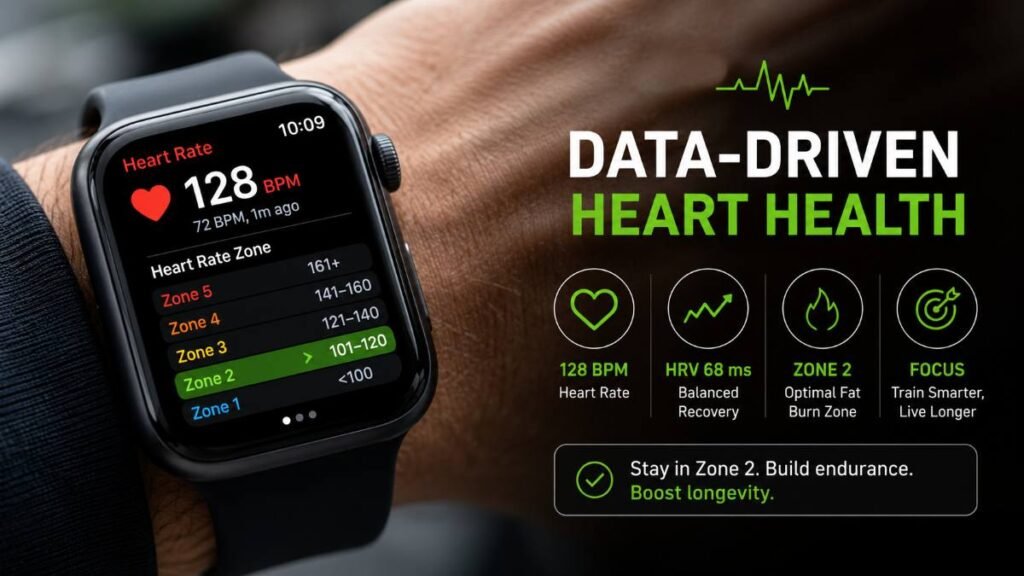
In 2026, you shouldn’t be training blind. Utilizing wearable technology is essential when executing Zone 2 Cardio Protocols for Longevity to ensure you stay in the correct metabolic window. Your heart rate is your primary diagnostic tool; if it exceeds your aerobic threshold, you are training for performance, not for long-term health. Keep an eye on your heart rate variability (HRV) as it serves as a great indicator of your autonomic nervous system’s recovery, a metric supported by clinical data in studies on athlete readiness. For more insights on how to leverage tech, read about HRV Tracking Apple Watch Longevity.
- HRV Analysis: A high HRV indicates a balanced nervous system, ready for the next session.
- VO2 Max Integration: Periodically testing VO2 max provides a hard metric for your aerobic ceiling.
- Continuous Glucose Monitoring (CGM): Ideal for observing how Zone 2 stabilizes blood glucose levels in real-time, preventing insulin resistance.
Resting Heart Rate: A decreasing resting HR over months is a classic sign of improved stroke volume and aerobic capacity
Nutritional Synergy for Metabolic Health
 Nutritional Synergy for Metabolic Health
Your cardio work is only as effective as the fuel you provide your body. To support Zone 2 Cardio Protocols for Longevity, your diet should prioritize stable blood sugar and adequate protein. As highlighted by the Harvard T.H. Chan School of Public Health, long-term metabolic health depends on high-quality, plant-forward nutrition. Many high-performers find that incorporating Healthy High Protein Foods For Fat Loss helps maintain muscle mass while keeping insulin levels low—a key requirement for longevity. Avoid the “carb-loading” trap; instead, focus on whole-food nutrition that supports sustained energy.
- Insulin Sensitivity: Stable blood glucose levels are essential for efficient fat metabolism during aerobic work.
- Protein Synthesis: Essential amino acids are critical for repairing tissue post-training to prevent sarcopenia.
- Anti-Inflammatory Focus: Emphasizing Omega-3 fatty acids over processed oils reduces systemic inflammation markers.
- Hydration/Electrolytes: Maintaining mineral balance prevents muscle cramping and cognitive fatigue during longer endurance sessions.
Balancing Strength and Aerobic Training
 Balancing Strength and Aerobic Training
The most robust bodies are built on a hybrid foundation: strength for structural integrity and aerobic capacity for heart health. When balancing Zone 2 Cardio Protocols for Longevity with resistance training, avoid doing your heavy lifting immediately before your cardio. Instead, try to split them, or perform your cardio on non-lifting days to ensure your nervous system has time to recover. If you need a routine that complements your cardio, check out this Home Back Workout Without Equipment. Maintaining muscle mass is just as critical as maintaining your VO2 max for aging gracefully.
- Interference Effect: Carefully spacing strength and cardio prevents the body from receiving “conflicting” signals (building muscle size vs. endurance).
- Structural Integrity: Strength training protects bones and connective tissue, which is essential as you age.
- Hybrid Athlete Model: The goal is to reach high functional strength without sacrificing aerobic efficiency.
Recovery Prioritization: Use active recovery days to keep the lymphatic system moving without taxing the muscles or joints.
Ready to overhaul your entire lifestyle? Stop the guesswork and master your diet with this comprehensive Master Your Diet In The UK guide to unlock your peak potential!

Boosting Cognition and Neuroplasticity
 Boosting Cognition and Neuroplasticity
Beyond the heart and muscles, Zone 2 Cardio Protocols for Longevity have profound impacts on the brain. The increased blood flow and improved metabolic health help clear out the “brain fog” that plagues many high-stress professionals. Research consistently shows that steady-state exercise promotes the release of BDNF (Brain-Derived Neurotrophic Factor), a protein crucial for neuron growth and synaptic plasticity. If you feel like your mental edge is dulling, don’t just reach for supplements; start moving. You can also explore Neuro Nutrients Guide 2026 Focus Memory to see how specific nutrients work in tandem with exercise.
- BDNF Upregulation: Exercise triggers the brain to produce more of this “miracle-gro” for neurons, improving executive function.
- Neurogenesis: Steady aerobic flow encourages the birth of new neurons in the hippocampus, which is vital for memory storage.
- Inflammation Control: Low-impact cardio reduces neuro-inflammation, which is a major contributor to cognitive decline.
- Stress Reduction: Low-intensity movement is highly effective at modulating cortisol pathways, keeping your nervous system calm and focused.
Overcoming Common Training Plateaus
 Overcoming Common Training Plateaus
Even the best plans can fail if you fall into common traps. The biggest mistake people make with Zone 2 Cardio Protocols for Longevity is over-complicating the movement or getting bored. You don’t need fancy equipment—brisk incline walking, steady cycling, or even rowing works. If you feel stuck, try varying your modality to keep your joints healthy. For those struggling with stubborn fat, it’s also worth investigating if Cortisol Belly Fix is relevant to your situation, as high stress can often override the benefits of your training. Keep it simple and consistent.
- Modality Fatigue: Rotate between cycling, swimming, and incline walking to prevent repetitive stress injuries.
- The “Junk Mile” Trap: If your heart rate drifts too high, you are no longer in Zone 2. Slow down to speed up your results.
- Environment Matters: Outdoor aerobic work has additional benefits for circadian rhythm and mental health.
- Accountability: Use a partner or a tracking app to stay consistent when motivation naturally wanes, as consistency beats intensity every time.

The Future of Bio-Optimized Living
 The Future of Bio-Optimized Living
As we look ahead, the integration of technology and biological testing will define the future of health. Adopting Zone 2 Cardio Protocols for Longevity is your ticket to being ahead of the curve. By tracking your VO2 max and metabolic markers, you are participating in a proactive model of care that moves away from the reactive “sick-care” system. For more on the evolution of health, see Wellness Trends Future Health Longevity. As clinical research from institutions like Mayo Clinic continues to highlight, proactive lifestyle management is the most powerful medicine we have. You have the tools; now, put them to work.
- Predictive Medicine: Use current markers to predict and prevent future metabolic declines before they become diagnostic issues.
- Long-term Tracking: Longevity is a decades-long game; look for trends over months, not days.
- Personalized Metrics: Every body is different; calibrate your zones based on your own lactate testing if possible.
- Sustainable Habituation: Design a life where health optimization is the “default” state, not a temporary effort.
Final Verdict
Zone 2 Cardio Protocols for Longevity are a fundamental investment in your biological capital. By optimizing mitochondrial efficiency, you effectively “future-proof” your heart and brain. Treat this steady-state movement as a non-negotiable pillar of your lifestyle to significantly extend your functional healthspan and vitality.
“Don’t train blind—invest in the right tools. The Garmin HRM-Pro Heart Rate Strap is a game-changer for long-term health tracking.”

Frequently Asked Questions
Is Zone 2 better than HIIT? It builds the critical aerobic base and mitochondrial density that HIIT cannot, making Zone 2 Cardio Protocols for Longevity superior for long-term healthspan.
How often should I train? Aim for 150–180 minutes of aerobic work weekly, ideally split into 3–4 sessions to maximize the benefits of Zone 2 Cardio Protocols for Longevity.
How do I gauge intensity? Use the “Talk Test”—you should be able to hold a conversation but not sing.
Does it aid weight loss? Yes, by improving metabolic flexibility, Zone 2 Cardio Protocols for Longevity help your body become highly efficient at burning stored fat as its primary fuel source.
✍️👤 About the Author
Dambar R. is a dedicated wellness researcher and the visionary founder of MyHealthyLifeUK. With over a decade of hands-on experience in metabolic science and practical nutrition, he specializes in creating sustainable health transformations for modern lifestyles.
Based on his extensive research, Dambar empowers individuals across the UK and USA to reach their peak fitness goals through science-backed health tips without sacrificing the joy of everyday eating. His mission is to bridge the gap between complex health data and actionable habits that foster long-term vitality and holistic wellness.
⚠️ Medical Disclaimer
The information provided on MyHealthyLifeUK is for educational and informational purposes only. It is not intended to be a substitute for professional medical advice, diagnosis, or treatment.
- Professional Guidance: Always seek the advice of your Physician (GP) or another qualified health provider regarding any medical condition.
- Specialized Advice: For personalized dietary needs, we recommend consulting a Registered Dietitian.
- Safety First: Consult a professional before starting any new fitness or nutrition program.
Never disregard professional medical advice or delay seeking it because of something you have read on this website.