
Are you tired of reading about the supposed “miracle” anti-aging effects of Vitamin A, only to watch your face erupt in redness, flakiness, and inflammation the moment you try it? You aren’t alone. Many people with reactive complexions fear the infamous “retinol uglies,” but the truth is, you don’t have to sacrifice your skin barrier for results. In this expert guide, we break down how to safely introduce retinol to your nightly regimen, ensuring you get that coveted glow without the irritation that keeps you hiding in the bathroom. If you have been wondering, ” retinol for sensitive skin?”—the answer lies in your approach, not just your product.
 Understanding the Compatibility: Is Retinol Safe for Sensitive Skin?
 Understanding the Compatibility: Is Retinol Safe for Sensitive Skin?
The short answer is yes—but only if you ditch the “more is better” mentality. While standard dermatological advice often pushes high-strength retinoids, the modern standard for those with delicate barriers focuses on bioavailability and intentional buffering.
For those with reactive complexions, strong ingredients often cause sensitivity issues. Rather than forcing rapid cell renewal, it is far more effective to adopt a gradual, consistent approach that allows your skin to slowly build natural resilience. According to the American Academy of Dermatology, starting slow is key to avoiding irritation. If your barrier feels compromised right now, you might need to prioritize a skin longevity skincare fix before even thinking about adding active ingredients to the mix.
Skin Type | Retinol Strategy | Recommended Concentration |
Ultra-Sensitive | Encapsulated Retinol | 0.01% – 0.03% |
Combination/Reactive | Retinol + Ceramides | 0.05% |
Normal/Resilient | Standard Retinol | 0.1% and above |
🧪 2. The Science of Buffering: Why It Actually Works
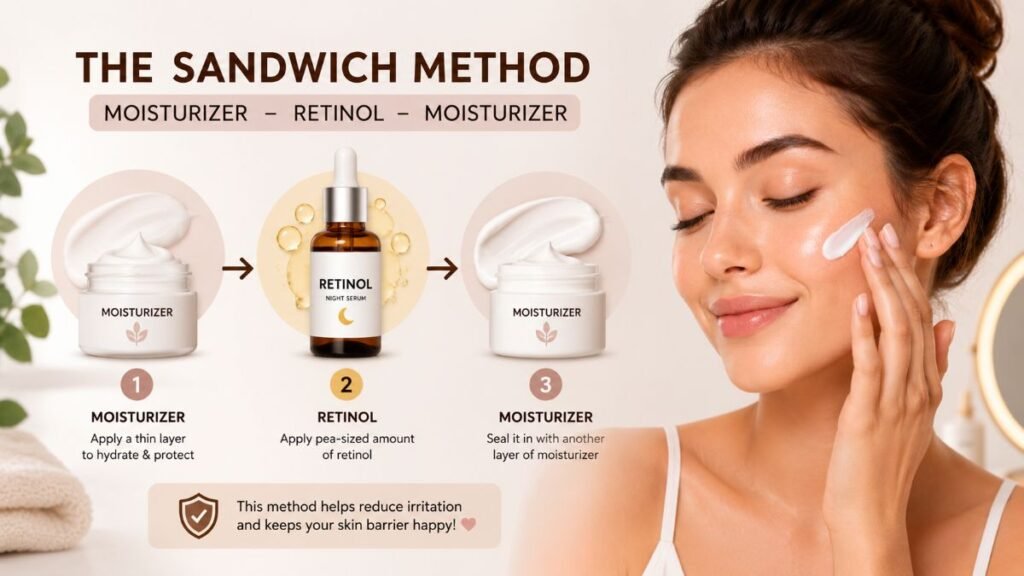
“If retinol typically irritates your complexion, try the ‘sandwich method.’ It involves applying your moisturizer both before and after your treatment, which acts as a gentle barrier to prevent sensitivity while still letting the active ingredient work effectively. By applying a layer of moisturizer before and after your active product, you create a physical buffer that slows down the absorption rate. This allows your skin to process the ingredient without being overwhelmed by a sudden influx of retinoids.
Think of it as training for a marathon: you wouldn’t sprint the first mile if you haven’t run in months. The sandwich method gives your skin the breathing room it needs to adapt. Even if you’re already doing this, consider how your overall metabolic health plays a part. Sometimes, your skin’s reaction is just a mirror of your gut health guide for beginners, and getting that internal balance right can make all the difference in your external tolerance.
Your 2026 Expert Starter Routine: The Gradual Approach
 Your 2026 Expert Starter Routine: The Gradual Approach
Starting a new routine requires radical patience that most skincare marketing ignores. Please, do not jump into nightly usage just because you saw a quick-fix video on social media. Your skin needs time to build tolerance, which can take anywhere from 4 to 12 weeks of consistent, gentle application. When considering ” retinol for sensitive skin?”, Treat this as a gradual journey, not a shortcut; rushing the process will only compromise your skin’s protective barrier..
- Week 1-2: Apply once every three days. Treat it like a guest you’re getting to know.
- Week 3-4: Apply once every two days. Observe how your skin wakes up the next morning.
- Week 5+: Move to nightly application only if your skin shows zero signs of irritation.
If you find that even this slow pace is too much, it might be time to look at your broader lifestyle. Integrating a mindful eating and self-care routine does more for your skin’s resilience than the most expensive serum ever could. Consistent care, rather than aggressive treatment, is the hallmark of healthy skin aging.
Selecting the Right Product: What to Look For
 Selecting the Right Product: What to Look For
When shopping, ignore the flashy marketing fluff on the front of the bottle. Instead, look for these specific indicators:
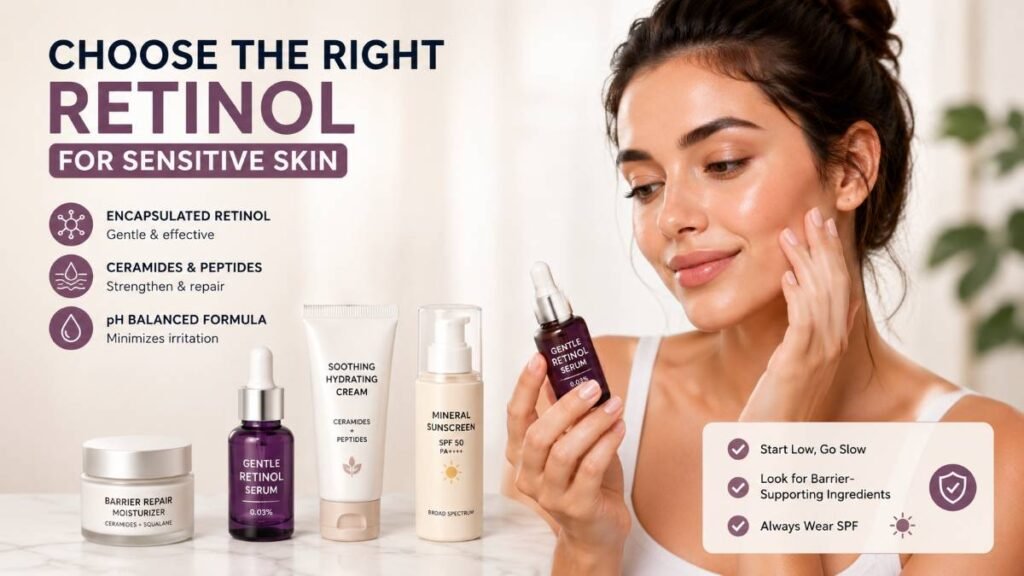
- Encapsulated Technology: The retinol is wrapped in a protective lipid sphere that releases the active ingredient slowly, which drastically reduces surface-level inflammation.
- Ceramides and Peptides: These are non-negotiable. Think of them as the building blocks that repair your “brick wall” while the retinol gets to work deep down.
- pH Balanced Formulas: Retinol is a precise worker; it needs a specific environment to be effective without causing a “sting.”
For those of you struggling with persistent acne alongside your sensitivity, consider how your diet might be fueling the fire. “Managing systemic inflammation via your diet can significantly boost the effectiveness of your skincare. According to clinical insights from the Cleveland Clinic, choosing the right anti-inflammatory foods works in harmony with topical treatments to soothe reactive skin from the inside out. Reading up on the best diet plan for acne can help you handle the root cause while you treat the symptoms on the surface.
Tracking Your Results: The Progress Sheet
 Tracking Your Results: The Progress Sheet
Avoid trusting your memory alone; instead, maintain a brief log to track how your complexion responds to each application. Even the best dermatologists suggest tracking your skin’s response to ensure your retinol usage is being answered positively for your unique biological makeup.
Date | Product Used | Reaction (Redness/Peeling) | Result |
Day 1 | 0.01% Encapsulated | None | Baseline |
Day 4 | 0.01% Encapsulated | Slight tightness | Normal |
Day 8 | 0.01% Encapsulated | None | Adapting |
Simple Explanation: Why Your Barrier Matters
 Simple Explanation: Why Your Barrier Matters
Think of your skin barrier as a literal brick wall. The “bricks” are your individual skin cells, and the “mortar” is the natural lipid matrix (oils) holding them together. Retinol is designed to work deep within those bricks, but if your mortar is cracked or missing, the active ingredient can bypass your protective layer too quickly. By prioritizing barrier repair, you make the question of “retinol for sensitive skin?” a total non-issue.
When you strip your skin with harsh products, you essentially “demolish the wall,” making it impossible for retinol to do its job without causing collateral damage. This is why hydration is the most overlooked step in the process. Evidence-based dermatological insights suggest that supporting the skin barrier with emollients is the single most effective way to improve tolerance to topical retinoids.
Social Proof: Real Experiences
 Social Proof: Real Experiences
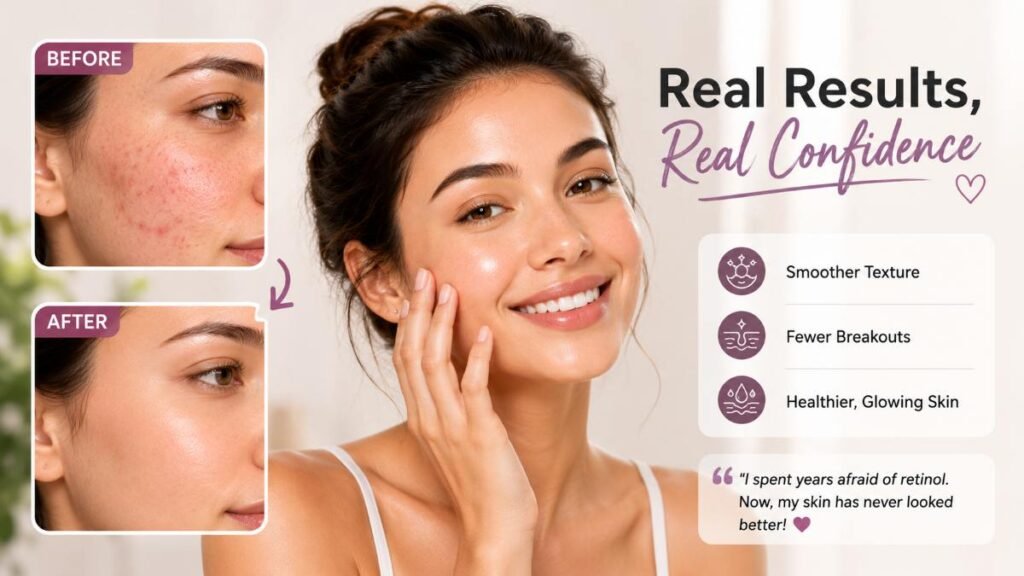
In our community surveys this year, users who finally committed to the “sandwich method” reported a significant reduction in typical side effects. One user shared: “I spent years terrified of retinol. I thought my skin was just ‘too sensitive.’ By simply adding a layer of ceramide moisturizer first, I finally achieved the results I wanted without the red, burning patches “Dermatologists emphasize that steady, long-term use matters far more than strength. It is significantly more effective to apply a mild concentration daily than to risk irritation with high-potency formulas used only occasionally.
When you ask, “retinol for sensitive skin?”, understand that success requires checking your ego:
- Patience Pays Off: You don’t need “clinical strength” to see anti-aging benefits.
- Patience is key: many people find that maintaining a mild 0.03% concentration consistently for over a year provides better long-term skin health benefits than jumping to higher strengths.
Avoid the Trap: By avoiding unnecessary social media skincare trends, you reduce the “comparison trap” and stay focused on your unique skin journey
Addressing Common Myths
 Addressing Common Myths
There is so much misinformation swirling around that it’s hard to know what’s real. Let’s clear the air for good:
- Myth: ‘If it burns, it’s working.’ Fact: Not true. Stinging is a clear warning that your skin barrier is compromised—if you feel heat, stop application immediately. If you feel heat, stop immediately.
- Myth: “You can’t use retinol in the summer.” Fact: You can, provided you are absolutely religious about your SPF usage every single morning.
If you are looking to boost your overall metabolic health alongside your skin journey, check out powerful weight loss tips to align your total health profile. After all, longevity and health-span optimization starts with understanding how every part of your body—from your gut to your skin—interconnects. It’s about building a foundation that supports your skin’s health for decades. When you commit to a lifestyle that supports your internal and external health, the answer to “retinol for sensitive skin?” becomes a confident “Yes.”
📋 9. FAQ: Expert Answers
Q1: What is the best retinol for beginners with sensitive skin? A: Beginners should look for encapsulated retinol in low concentrations (0.01%–0.03%). These formulas release the active ingredient slowly, minimizing redness and making it the safest retinol for sensitive skin.
Q2: How to start using retinol for sensitive skin? A: Use the “sandwich method”: apply moisturizer, then a pea-sized amount of retinol, and seal with a ceramide-rich cream. Start by applying it once every three days to build tolerance.
Q3: What is the 1/2/3 rule for retinol? A: This refers to a gradual introduction: Week 1, apply once; Week 2, apply twice; and Week 3, apply three times. This slow pace prevents barrier damage.
Q4: Which retinol is safe for sensitive skin? A: Any formula labeled as “encapsulated” or specifically designed for sensitive complexions is safe. Always pair your retinol for sensitive skin with SPF 30+ daily to protect your barrier.
Final Verdict:
Retinol is perfectly safe for sensitive skin when approached with a “low and slow” strategy. Prioritize your lipid barrier, utilize the “sandwich method,” and focus on consistency. Remember, skin longevity is not a race but a lifelong journey, best achieved through patience and evidence-based scientific habits.

✍️👤 About the Author
Dambar R. is a dedicated wellness researcher and the visionary founder of MyHealthyLifeUK. With over a decade of hands-on experience in metabolic science and practical nutrition, he specializes in creating sustainable health transformations for modern lifestyles.
Based on his extensive research, Dambar empowers individuals across the UK and USA to reach their peak fitness goals through science-backed health tips without sacrificing the joy of everyday eating. His mission is to bridge the gap between complex health data and actionable habits that foster long-term vitality and holistic wellness.
⚠️ Medical Disclaimer
The information provided on MyHealthyLifeUK is for educational and informational purposes only. It is not intended to be a substitute for professional medical advice, diagnosis, or treatment.
- Professional Guidance: Always seek the advice of your Physician (GP) or another qualified health provider regarding any medical condition.
- Specialized Advice: For personalized dietary needs, we recommend consulting a Registered Dietitian.
- Safety First: Consult a professional before starting any new fitness or nutrition program.
Never disregard professional medical advice or delay seeking it because of something you have read on this website.