
Foundational Insight
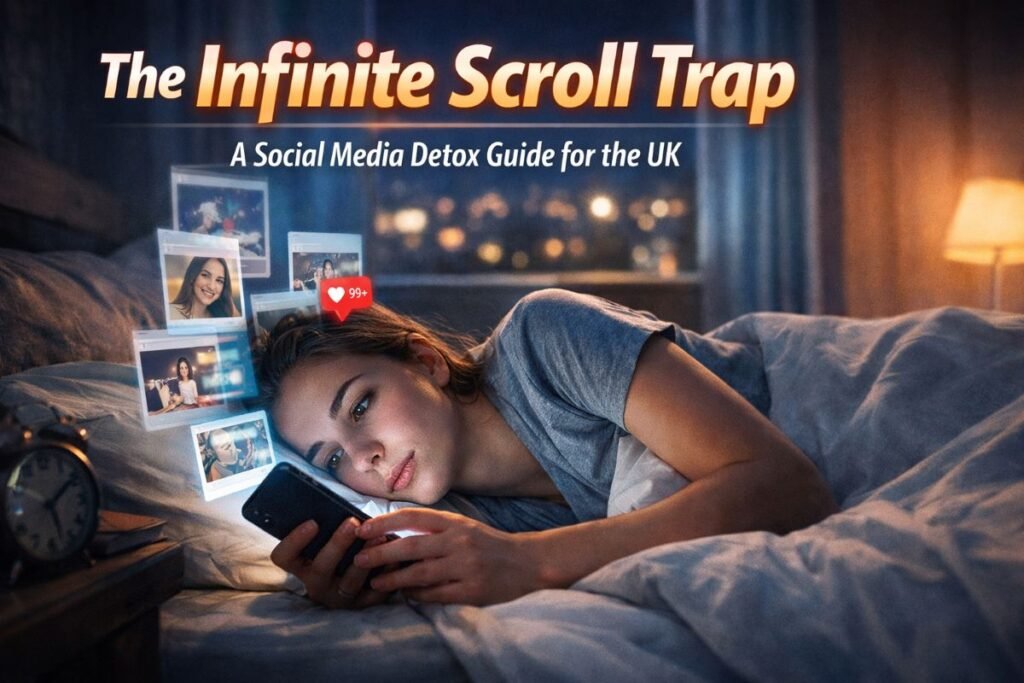
It’s 11:30 PM in a quiet British suburb, and while the world sleeps, millions of us are caught in the blue-light glow of the “Infinite Scroll .” We tell ourselves “just five more minutes,” but an hour vanishes into a void of 15-second clips and curated lifestyles that make our own lives feel inadequate. In 2026, the UK is facing a mental health crossroads; we are more connected than ever, yet record numbers of Brits report feeling profoundly lonely. The “Infinite Scroll Trap” isn’t just an app feature—it’s a sophisticated psychological hook designed to keep you from your own life. This guide is your emergency exit. It’s time to move beyond the screen and rediscover the Social Media Detox in the UK as a path to genuine mental freedom.
1. The Psychology of the Scroll: Why Your Brain Can’t Let Go
To escape the trap, you must first understand how it’s built. Most apps are designed like Las Vegas slot machines, using “variable reward schedules” to keep you hooked. Every flick of your thumb is a gamble—will the next post be a funny meme, a piece of shocking news, or a life-changing update? This uncertainty is exactly what makes a Social Media Detox in the UK so difficult to start. Your brain is essentially being “hacked” by world-class engineers whose only goal is to steal your attention.
In my experience, the hardest part is admitting that we aren’t in control. We think we are “using” social media, but often, the social media is using us. In the UK, where the “hustle culture” of London meets the quiet pressure of social etiquette, this constant stream of information creates a “cognitive overload.” By understanding that the scroll is a design choice and not a personal weakness, you take the first step toward reclaiming your focus and your time.
2. The Comparison Trap: How "Perfect" Lives Fuel British Anxiety
One of the most damaging side effects of our digital age is the “Comparison Trap.” We compare our “behind-the-scenes” footage with everyone else’s “highlight reel.” In 2026, with AI-enhanced filters making reality look dull, this has led to a surge in body dysmorphia and social anxiety across the UK. A Social Media Detox in the UK is often the only way to reset your baseline of what a “normal” life looks like.
I’ve spoken to many people who felt like failures because their weekends didn’t look like an influencer’s trip to the Cotswolds. The reality? Most of those “perfect” moments are staged, edited, and void of actual joy. When you step away from the feed, you stop measuring your worth against a filtered lie. You start noticing the beauty in your own messy, unfiltered, and authentic British life—which is where true happiness actually lives.
3. Beyond the Brain: Social Media Detox vs. Dopamine Detox
You might have heard of a Dopamine Detox, which focuses on the biological receptors in your brain. However, a Social Media Detox in the UK is more about “Digital Hygiene” and emotional boundaries. While a dopamine reset targets all high-stimulation activities like junk food or gaming, this digital detox specifically targets the “Social Comparison” and “Information Fatigue” that comes from being constantly plugged into a global hive-mind.
Think of it this way: Dopamine Detox is the surgery, but Digital Minimalism is the daily lifestyle that keeps you healthy. In the UK, where we are increasingly working from home, the lines between professional networking and personal scrolling have blurred. By separating these two concepts, you can target the specific apps that drain your energy without having to live like a monk. It’s about being surgical with your digital cuts to protect your mental space
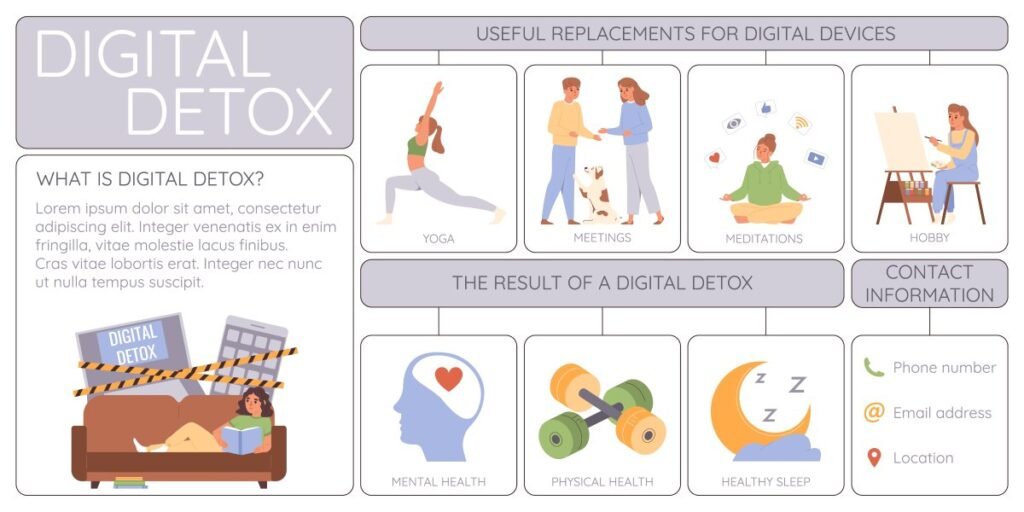
4. The 2026 UK Digital Landscape: Why Now is the Time to Unplug
The UK’s relationship with technology has reached a tipping point in 2026. With the “Online Safety Act” now in full swing, there is more awareness than ever about the harms of excessive screen time. However, legislation can only do so much. The responsibility for a Social Media Detox in the UK falls on the individual. We are seeing a “Digital Divide” where the most successful and happy individuals are those who have learned to put their phones down.
In cities like Bristol and Edinburgh, “Phone-Free Cafes” and “Analog Socials” are becoming the new trend. People are craving real, eye-to-eye contact that isn’t interrupted by a notification chime. If you feel like your attention span has shrunk to the size of a TikTok video, you aren’t alone. The British public is waking up to the fact that our “free” apps are actually costing us our mental peace and our ability to think deeply.
5. From FOMO to JOMO: Finding Joy in Missing Out
At some point, most of us have experienced the uneasy feeling known as FOMO—the fear of missing out . That nagging feeling that everyone else is at a better party or having a more profound experience. But the secret to a successful Social Media Detox in the UK is transitioning into JOMO: The Joy of Missing Out. It’s the realization that you don’t need to know what a celebrity had for breakfast or what your high school rival thinks about politics.
JOMO is about being present. It’s about the peace of mind that comes when you realize that “missing out” on the digital noise means “tuning in” to your real life. Whether it’s a quiet walk in the Peak District or finally finishing that book on your nightstand, JOMO gives you your soul back. In 2026, being “unavailable” is the new status symbol. It shows that you have something more interesting going on in the real world than what’s happening on a 6-inch screen.
6. Practical Steps: How to Start Your Digital Declutter
Don’t just “try” to scroll less; you need a system. A Social Media Detox in the UK requires a structured approach to be successful. Start by performing an “App Audit.” Go through your phone and delete any app that makes you feel bad after using it. If you can’t delete it, move it off your home screen into a hidden folder. Reducing visibility naturally lowers the chances of it occupying your attention.
Another powerful trick is turning your phone to “Grayscale” mode. Most apps use bright red notification bubbles and vibrant colors to trigger your brain’s reward system. When you strip away the color, the apps look dull and uninviting. Suddenly, Instagram looks like a boring newspaper, and your brain loses interest. This small British “life hack” is often more effective than any willpower-based strategy because it tackles the problem at the sensory level.
7. The "Digital Sunset" Ritual: Reclaiming Your British Evenings
In the UK, our evenings are precious, yet we often waste them staring at blue light that wreaks havoc on our sleep. Implementing a “Digital Sunset” as part of your Social Media Detox in the UK can be life-changing. This means that at least two hours before bed, all social media apps are off-limits. Use this time for activities that actually nourish you—cooking a real meal, listening to a podcast, or practicing a hobby.
I’ve found that the first few nights are the hardest. You’ll find your hand reaching for your phone like a phantom limb. But after a week, the “Digital Fog” begins to lift. You’ll find you have more to talk about with your partner, your sleep becomes deeper, and that morning “brain fog” starts to disappear. Reclaiming your evenings is about reclaiming the transition from a busy workday to a restful night—something that social media is designed to prevent.
8. Social Media and the Workplace: Managing Professional Connectivity
For many Brits, the excuse for not starting a Social Media Detox in the UK is work. Many people feel obligated to stay active on platforms like LinkedIn for professional visibility or to handle company accounts. While that responsibility is real, it doesn’t require being constantly connected. key is to treat social media like a utility, not a pastime. Check it at specific times—say, 10 AM and 3 PM—and then close the tab.
In 2026, the best UK employers are actually encouraging “Digital Boundaries.” They realize that a distracted employee is an unproductive one. If you use social media for work, try to use a desktop computer instead of your phone. The “friction” of having to sit at a desk and type on a keyboard makes it much less likely that you’ll fall into a 2-hour scroll hole. Set your boundaries clearly, and you’ll find that your professional life actually improves when you aren’t constantly interrupted by digital noise.
9. Reconnecting with the Real UK: Analog Hobbies and Socializing
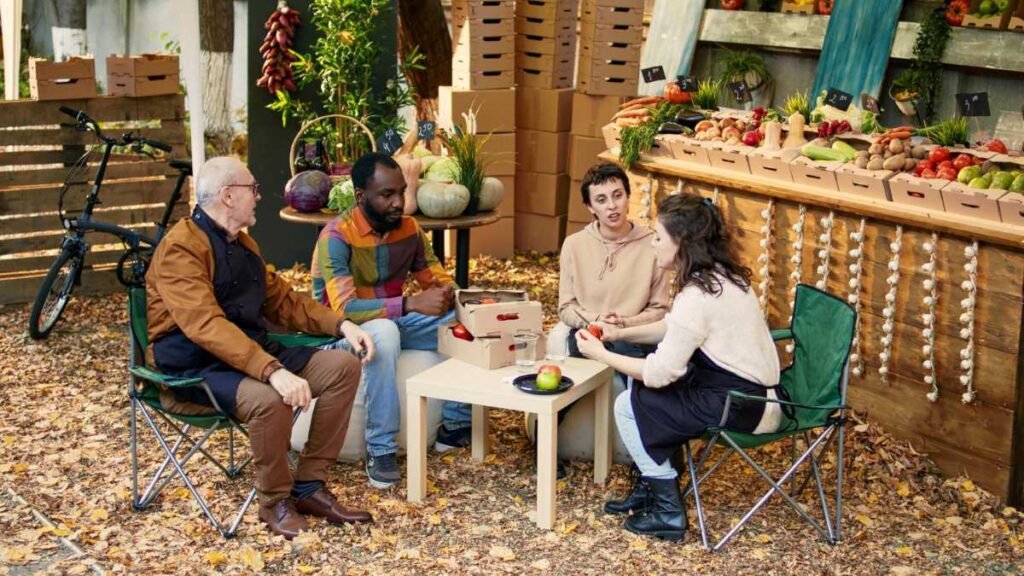
The ultimate goal of a Social Media Detox in the UK is to fill the vacuum left by your phone with something meaningful. We often forget that we have access to some of the world’s most beautiful landscapes and vibrant local communities. Rather than just tapping ‘like’ on a hiking photo, step outside and experience it yourself. Instead of “commenting” on a friend’s post, invite them for a coffee at a local independent shop.
Analog hobbies—like gardening, painting, or even joining a local football club—provide a “Flow State” that social media can never replicate. This is where your brain is fully immersed in a task, losing track of time in a healthy way. In 2026, meaningful real-life connections have become increasingly rare and valuable . By stepping away from the screen, you are making space for the experiences that actually make life worth living in Great Britain.
10. The 7-Day Social Media Detox Challenge
If you’re ready to break the trap, I recommend the “7-Day UK Reset.” This isn’t about quitting forever; it’s about breaking the habitual “twitch” of checking your phone. A Social Media Detox in the UK for one week is enough time to see the benefits without feeling completely isolated.
- Day 1-2: Delete the apps. Expect irritability and boredom—this is your brain “detoxing.”
- Day 3-4: The “Boredom Peak.” This is when you’ll start noticing how much extra time you have. Fill it with a book or a walk.
- Day 5-6: The Clarity Phase. You’ll notice your focus returning. You’ll feel less anxious about what others are doing.
- Day 7: The Reflection. Before you re-install any apps, ask yourself: “Do I actually miss this, or was I just bored?”
Social Media Detox vs. Dopamine Detox: Key Differences
Feature | Social Media Detox in the UK | Dopamine Detox (General) |
Primary Goal | Emotional Peace & Focus | Biological Reset of Receptors |
Main Target | Instagram, TikTok, Facebook | Sugar, Gaming, Porn, All Stimulants |
UK Context | Combatting FOMO & Comparison | Combatting Burnout & Addiction |
Duration | Usually 7-30 Days | Usually 24-48 Hours (Hard Reset) |
Outcome | Improved Real-World Relationships | Increased Base Level of Joy |
The “Infinite Scroll ” Escape Plan
- Trigger: Feeling bored or stressed.
- Old Action: Open Instagram and scroll for 45 minutes.
- New Action (The Detox Way): 5 minutes of deep breathing or making a cup of tea.
Result: Reduced anxiety and a sense of being in control of your time.
Frequently Asked Questions
Q: Will I lose my friends if I go on a Social Media Detox in the UK?
A: Paradoxically, no. You might lose “digital acquaintances,” but your real friendships will likely strengthen. You’ll find yourself texting or calling people directly, leading to more meaningful and deep conversations than a “like” could ever provide.
Q: What if I need social media for my business?
A: Use “Posting Tools.” Schedule your content in advance using platforms like Buffer or Hootsuite. This allows you to maintain a professional presence without having to dive into the toxic “Feed” every day.
Q: Is it okay to just “limit” my time instead of a full detox?
A: For some, yes. But for many, social media is like a “digital drug.” It is much easier to stay at 0 minutes than it is to stop at 15 minutes. A full Social Media Detox in the UK for a short period helps “reset” your habit so that moderation becomes possible later.
Reclaiming Your Life from the Algorithm
The “Infinite Scroll Trap” is a battle for your soul, your time, and your mental health. In a world that profits from your distraction, paying attention to your real life is an act of bravery. By committing to a Social Media Detox in the UK, you aren’t “missing out”—you are opting in. You are opting into deeper thoughts, better sleep, and more authentic connections. Don’t let a piece of glass in your pocket dictate the quality of your day. Turn the screen off, look up, and start living the life that is happening right in front of you.
Expert Tip: If you feel the urge to scroll, try the “3-Breath Rule.” Take three deep breaths before you open any app. Most of the time, the urge will pass, or you’ll realize you were just looking for an escape from a moment of minor stress. Awareness is the ultimate “App-Blocker.”
✍️ About the Author
Dambar R. is a dedicated wellness researcher and the visionary founder of MyHealthyLifeUK. With over a decade of hands-on experience in metabolic science and practical nutrition, he specializes in creating sustainable health transformations for modern lifestyles.
Based on his extensive research, Dambar empowers individuals across the UK and USA to reach their peak fitness goals through science-backed health tips without sacrificing the joy of everyday eating. His mission is to bridge the gap between complex health data and actionable habits that foster long-term vitality and holistic wellness.
⚠️ Medical Disclaimer
The information provided on MyHealthyLifeUK is for educational and informational purposes only. It is not intended to be a substitute for professional medical advice, diagnosis, or treatment.
- Professional Guidance: Always seek the advice of your Physician (GP) or another qualified health provider regarding any medical condition.
- Specialized Advice: For personalized dietary needs, we recommend consulting a Registered Dietitian.
- Safety First: Consult a professional before starting any new fitness or nutrition program.
Never disregard professional medical advice or delay seeking it because of something you have read on this website.