
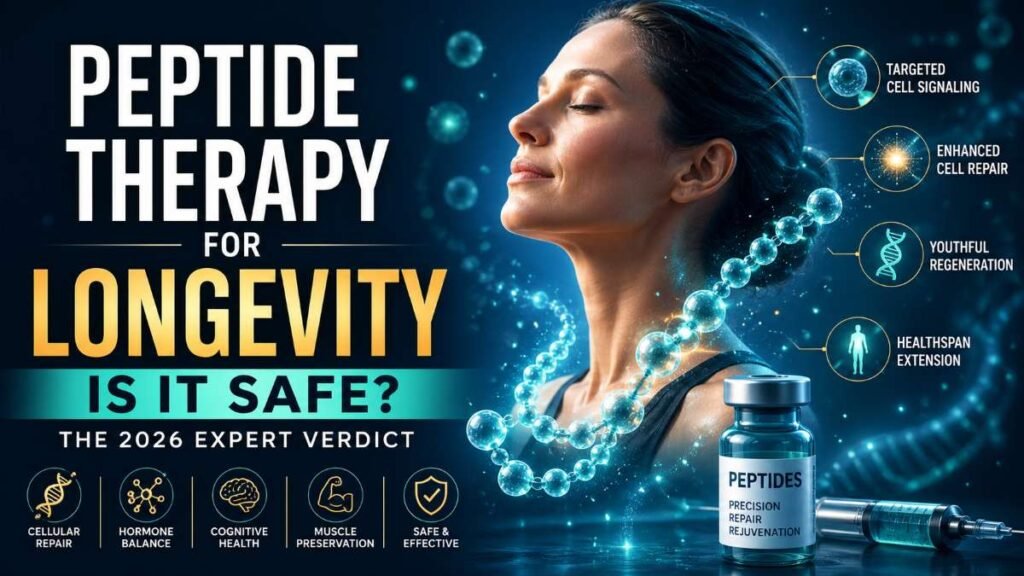
What if the secret to anti-aging isn’t a supplement, but a biological “text message” to your cells? In 2026, the UK’s caffeine-fueled “grind culture” is dead. Elite professionals are swapping shaky coffee jitters for the surgical precision of Peptide Therapy for Longevity. This isn’t another “skinny tea” trend; it’s a pharmacological shift in cellular repair. But as the line between experimental bio-hacking and clinical safety blurs, are you upgrading your biology or playing a dangerous game of self-experimentation?
Here is the 2026 expert verdict.
1. The Mechanism: What Exactly are Peptides?
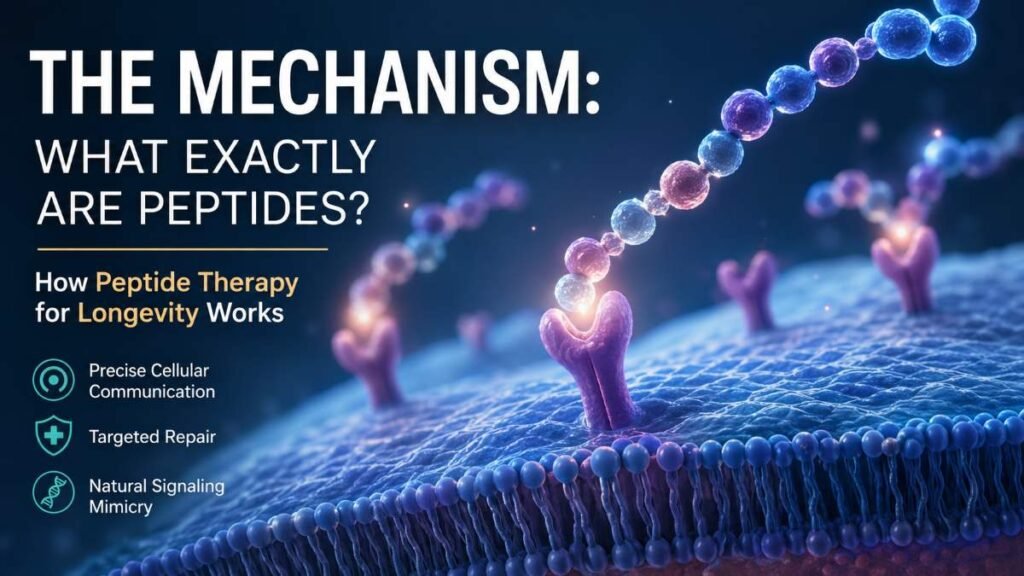
Peptides are essentially biological “messengers”—short chains of amino acids (usually 2 to 50) that tell your cells to perform a specific task, such as producing collagen or releasing growth hormones.
Unlike proteins, which are long and structurally complex, peptides are small enough to be absorbed and utilized as precise signaling molecules within the body’s vast communication network.
- Signaling Accuracy: Peptides act as highly specific “keys” that fit certain “locks” (receptors) in the body, ensuring a localized effect without disrupting systemic balance.
- Targeted Repair: Unlike broad supplements, peptides can be designed to signal specific tissues, such as the gastric mucosa or muscle fibers, making them a tool of precision medicine.
- Homeostatic Mimicry: They function by mimicking the natural signaling molecules our bodies produced in abundance during our youth, which may support normal biological function as we age.
In simple terms, this means instead of just flooding your body with generic nutrients, you are sending a text message directly to your cells to tell them to start repairing.
In practice, many patients experience a fundamental misunderstanding that Peptide Therapy for Longevity “adds” something to the body like a vitamin. They don’t; they signal.
However, if your underlying metabolic health is compromised due to poor sleep or chronic inflammation, the “signal” won’t be heard. Unlike anabolic steroids, which often shut down natural hormone production, certain longevity peptides work by “encouraging” the body’s own endocrine system.
This distinction is vital: peptides generally modulate existing pathways rather than forcing a supra-physiological state that the body can’t maintain.
2. The Science of Repair: How Signaling Works
Every bodily function—from tissue repair to stress-related abdominal fat accumulation—relies on precise cellular signaling.
When utilizing Peptide Therapy for Longevity, clinicians often aim to restore the “volume” of these biological signals that naturally fade after the age of 30.
From a pharmacological perspective, early research suggests that peptides activate specific cascades. For instance:
- Growth Hormone Secretagogues: Peptides like CJC-1295 and Ipamorelin signal the pituitary gland to release natural pulses of growth hormone, which has been hypothesised to aid in fat metabolism and muscle recovery.
- Mitochondrial Support: Emerging research suggests certain peptides may support the efficiency of the “cellular powerhouse,” potentially reducing oxidative stress at the mitochondrial level.
- Tissue Regeneration: The peptide BPC-157 is widely studied in preclinical models for its ability to promote angiogenesis (new blood vessel formation), though it remains in the “experimental” phase for human use.
It is critical to note that much of the current enthusiasm for peptides like BPC-157 is based on animal data and early-stage research—not large-scale human clinical trials. Meaningful progress in this field requires a cautious, evidence-based approach rather than early adoption based on anecdotal success.
🔍 2026 Longevity Peptide Matrix: Approved vs. Experimental
Peptide Name | Physiological Mechanism | Target Outcome | Regulatory Status (2026) |
BPC-157 | Angiogenesis | Tissue Repair | Experimental (Not FDA Approved) |
GHK-Cu | Collagen Synthesis | Skin Elasticity | Cosmetic Use (Widely Used) |
CJC-1295 | GH Secretagogue | Muscle Preservation | Prescription Required |
Semaglutide | GLP-1 Receptor | Weight Loss | FDA Approved (e.g., Ozempic) |
3. Navigating the 2026 Legal Landscape: Is It Safe?
The most critical question remains: Is Peptide Therapy for Longevity safe? As of early 2026, the regulatory landscape has become far more rigorous to protect consumers from substandard products.
Oversight has increased significantly via:
- U.S. Food and Drug Administration (FDA)
- Medicines and Healthcare products Regulatory Agency (MHRA)
- World Anti-Doping Agency (WADA)
Most individuals should not be experimenting with peptides without specialist medical supervision. The risks of “Grey Market” sourcing are severe, ranging from contamination with heavy metals to improper stabilization.
Clinicians often report cases of patients presenting with elevated liver enzymes simply because they bought “research chemicals” online. These are delicate proteins; if they aren’t kept at a specific temperature during shipping and storage, they become biologically inactive or potentially harmful.
Essentially, this means you might be injecting a degraded chemical that does nothing—or worse, triggers an immune reaction—rather than a therapeutic signal.
Self-administering these substances without a legitimate prescription is dangerous and medically irresponsible.
4. The "Ozempic Face" Connection: Volume Loss vs. Repair
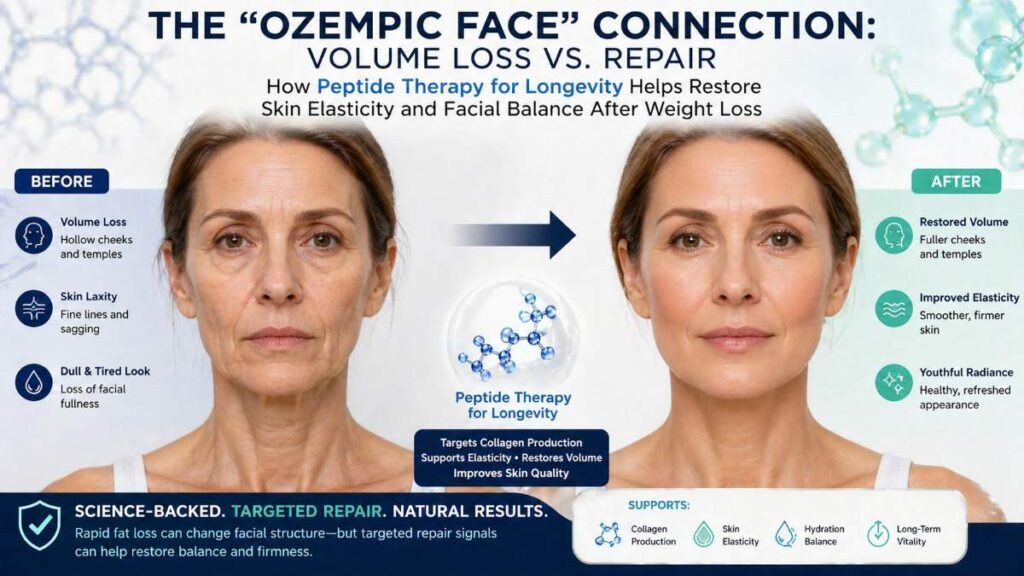
While Semaglutide revolutionized weight loss, it led to commonly reported facial volume loss—where rapid fat loss leaves skin deflated.
This occurs because the skin cannot always keep pace with the dramatic reduction in underlying subcutaneous fat, leading to a “gaunt” appearance.
In practice, many patients experience a desperate need for structural skin repair when transitioning off GLP-1 agonists, leading them toward Peptide Therapy for Longevity.
This is where GHK-Cu (Copper Peptides) have gained massive popularity. GHK-Cu is often applied topically to signal collagen and elastin production directly in the dermal layers.
Unlike oral weight-loss drugs, topical peptides focus on structural integrity. In 2026, the standard of care is a “360-degree approach”: you manage weight while actively signaling the skin to maintain its elasticity using approved dermatological peptides.
5. Who Should Avoid Peptide Therapy? (The Red Flags)
Medical writing must define “red flags” to ensure patient safety. Peptide Therapy for Longevity is not a universal solution.
You should strictly avoid or seek extreme specialist care if you have:
- History of Malignancy: Peptides that promote blood vessel growth (angiogenesis) could theoretically support tumor growth by providing a blood supply to dormant cancer cells.
- Uncontrolled Diabetes: Growth hormone secretagogues can impact insulin sensitivity and blood glucose levels, requiring constant monitoring.
- Active Hormonal Disorders: Thyroid or adrenal imbalances must be corrected first, as peptides can complicate an already volatile endocrine environment.
- Liver or Kidney Dysfunction: Processing synthetic proteins and their metabolites puts an additional load on these organs.
Proper screening via an NHS Health Check Over 40 is essential to rule out these underlying risks before considering any signaling therapy
6. Bio-Hacking vs. Medical Supervision: How to Start
If you are considering Peptide Therapy for Longevity, you must abandon the “DIY” mindset. 2026 longevity medicine relies on Biomarker Data rather than guesswork.
Establish a Baseline: Get comprehensive blood work, including IGF-1 and Kidney markers, through professional channels.
DNA Methylation: Use a Biological Age Test Kit to see if your internal age matches your calendar.
The “Off-Cycle” Rule: Never stay on a peptide protocol indefinitely. Receptors will eventually become “deaf” to the signal (tachyphylaxis).
Realistic Timelines: Most clinically supervised peptide protocols require 8–16 weeks before measurable changes appear in biomarkers or body composition.
Think of it this way: You are repairing a house, not painting a wall. The deeper structural work takes time to show on the outside. Some individuals may notice subtle changes earlier, but meaningful physiological adaptations typically require consistent adherence over several months.
7. The Vagus Nerve & Nervous System Synergy
Your nervous system is the primary “operating system” for your longevity. If you are in a state of chronic stress, your body prioritizes “survival” over “cellular repair,” making even advanced Peptide Therapy for Longevity less effective.
The synergy between a calm mind and a receptive gut is non-negotiable for long-term healthspan extension.
Vagal Tone: Stimulating the Vagus nerve through Somatic Exercises helps transition the body into the “Rest and Digest” state, which is necessary for repair.
Clinical Reality: Clinicians often observe patients spending thousands on peptides while sleeping four hours a night. This is a waste of resources.
Peptides cannot fix a lifestyle that is fundamentally broken. When cortisol levels are high, the body’s receptors for repair signals are far less responsive. To optimize your protocol, you must manage your stress levels as rigorously as your dosage.

8. Cognitive Longevity: The Brain-Peptide Axis
As the population ages, interest in neuro-specific applications of Peptide Therapy for Longevity has surged.
The brain’s environment is highly protected, meaning traditional supplements often fail to cross the barrier effectively. Peptides such as Semax and Selank are being studied for:
- BDNF Expression: Increasing Brain-Derived Neurotrophic Factor, essentially “fertilizer” for new brain cells and synaptic connections.
- Anxiety Modulation: Selank is noted for its ability to modulate the GABAergic system without the sedative side effects of traditional meds.
In simple terms, these peptides act like a “software update” for your mental processing speed.
The Clinical Hurdle: The “Blood-Brain Barrier” remains a formidable challenge. In practice, neuro-peptide protocols are found to be highly individualistic; what clears “brain fog” for one may produce zero effect in another.
This highlights the need for personalized dosing and professional oversight to ensure these peptides are effectively reaching their target.
9. Muscle Preservation: The Fight Against Sarcopenia
For those over 40, the loss of muscle mass (Sarcopenia) is a primary driver of metabolic decline and physical frailty.
Maintaining muscle is not just about aesthetics; it is about preserving metabolic flexibility and hormonal health as we age.
Visceral Fat Reduction: Tesamorelin is specifically FDA-approved for reducing lipodystrophy (deep belly fat) which is often resistant to diet alone.
Nitrogen Retention: Improving the body’s ability to utilize protein for muscle repair, especially important as protein synthesis naturally slows down.
Expert Consensus: Peptides are not a substitute for resistance training. The best results occur in patients who use peptides to enhance recovery from heavy lifting, not to replace the gym.
You must provide the physical stimulus (lifting) for the chemical signal (peptides) to have a structural purpose. Without the physical work, the metabolic signal lacks the necessary foundation to build lasting tissue.
Conclusion: The Future of Longevity
Peptide Therapy for Longevity is a precision biological tool, but it is not a miracle cure.
In 2026, we are moving away from the “Ozempic-only” mindset toward a more nuanced understanding of amino acid chains and how they interact with our unique biological blueprints.
The Expert Safety Checklist:
- [ ] Sourcing: Only use a licensed medical doctor; avoid “Research Use Only” sites.
- [ ] Monitoring: Conduct blood work every 90 days via clinical laboratories.
- [ ] Regulatory: Check the World Anti-Doping Agency list if you compete in sports, as many peptides are prohibited.
- [ ] Nutrition: Peptides require a high-protein Diet to provide the building blocks they signal for.
Longevity is a marathon. Peptides might be the high-performance fuel, but if your lifestyle “car” has no wheels, the fuel is useless.
True biological reset requires the basics—sleep, movement, and nutrition—to be optimized first. Peptides are simply the final adjustment on a machine that is already running well.
Longevity isn’t about adding more years—it’s about adding more function to the years you already have.
Frequently Asked Questions
Is peptide therapy legal in the UK?
Yes, but highly regulated. Many peptides require a prescription from a licensed medical professional. Sourcing them as “research chemicals” for human consumption is illegal and unsafe.
Can peptides actually reverse aging?
Peptides do not “reverse” time, but they may support the repair of tissues and metabolic functions, helping to extend your “healthspan.”
Are peptides safe for long-term use?
Most experts discourage continuous use. Protocols are typically cycled (e.g., 3 months on, 1 month off) to prevent receptor desensitization.
What are the potential side effects?
Common reports include hormonal imbalances, water retention, insulin resistance, and injection site reactions. Risk increases significantly with unsupervised use.
✍️👤 About the Author
Dambar R. is a dedicated wellness researcher and the visionary founder of MyHealthyLifeUK. With over a decade of hands-on experience in metabolic science and practical nutrition, he specializes in creating sustainable health transformations for modern lifestyles.
Based on his extensive research, Dambar empowers individuals across the UK and USA to reach their peak fitness goals through science-backed health tips without sacrificing the joy of everyday eating. His mission is to bridge the gap between complex health data and actionable habits that foster long-term vitality and holistic wellness.
⚠️ Medical Disclaimer
The information provided on MyHealthyLifeUK is for educational and informational purposes only. It is not intended to be a substitute for professional medical advice, diagnosis, or treatment.
- Professional Guidance: Always seek the advice of your Physician (GP) or another qualified health provider regarding any medical condition.
- Specialized Advice: For personalized dietary needs, we recommend consulting a Registered Dietitian.
- Safety First: Consult a professional before starting any new fitness or nutrition program.
Never disregard professional medical advice or delay seeking it because of something you have read on this website.