

Do you ever feel a lingering tightness in your chest or a deep-seated fatigue that even the best night’s rest won’t fix? It is often more than just being tired; it is your nervous system clinging to old emotional weight you thought was long gone. In 2026, the mental health focus in the USA is shifting. We are moving toward somatic exercises for trapped stress & trauma to unlock the silent messages stored in our muscles. This guide shows you how to communicate a sense of true safety to your nervous system, helping you finally shed the heavy burdens your body has been carrying for years.
What Are Somatic Exercises for Trapped Stress & Trauma?
At its core, somatic exercises for trapped stress & trauma are movement-based practices that focus on the internal physical experience rather than external appearance. Unlike traditional gym workouts that push you to “grind,” somatic work asks you to “feel.” It is based on the scientific understanding that trauma isn’t just a memory in the brain; it is a physiological state stuck in the body’s tissues. When we experience a threat, our body prepares to fight, flight, or freeze. If that energy isn’t “discharged,” it stays trapped in the Psoas muscle, the diaphragm, and the nervous system. Somatic work provides the safe container needed to finally let that energy go.
- 🧠 Mind-Body Bridge – Reconnecting the brain’s perception with the body’s actual sensations.
- 🌊 Nervous System Regulation – Shifting from a high-alert “Sympathetic” state to a calm “Parasympathetic” state.
- 🧘 Proprioceptive Awareness – Developing a deeper “inner map” of where you hold tension.
- 🔋 Energy Discharge – Physically releasing the adrenaline and cortisol that never left your system.
The Science of the "Body Keeping Score" in the USA
Somatic movements operate by recalibrating the nervous system, essentially flipping the biological switch from a state of “high alert” back to rest and recovery. This process directly impacts the body’s natural ability to discharge lingering tension. In the USA’s high-speed digital culture, our nervous systems often stay stuck in “Survival Mode.” By practicing somatic movements, you send a biological signal of safety to your brain, transitioning your body from chronic stress into a “Healing Mode.
📊 The Impact of Chronic Stress on US Adults (2026 Data)
Symptom Area Physical Manifestation Somatic Solution
Hormonal Chronic High Cortisol (Belly Fat) Gentle Rocking & Pelvic Tilts
Muscular Locked Psoas (Lower Back Pain) Psoas Release & Tremoring
Respiratory Shallow Chest Breathing (Anxiety) Diaphragmatic Breathwork
Neurological High Vigilance (Insomnia) Vagus Nerve Stimulation
Top 5 Somatic Exercises for Trapped Stress & Trauma You Can Do at Home
You don’t need a clinical setting to start your healing journey. These somatic exercises for trapped stress & trauma are designed to be low-impact and highly accessible. The key is “Interoception”—the ability to feel what is happening inside your skin. As you perform these, ignore how you look in the mirror and focus entirely on the micro-sensations in your muscles and joints.
- 🐚 The Body Scan & Pendiculation – Yawning and stretching like a cat to reset muscle length.
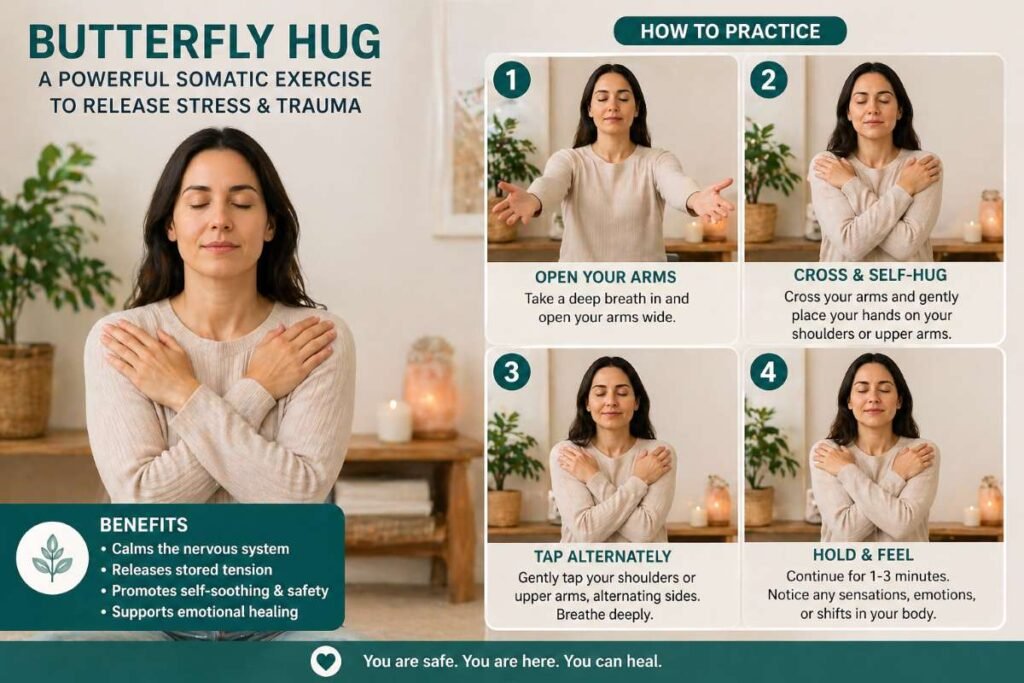
- 🦋 Butterfly Hugs & Tapping – Bilateral stimulation to calm the amygdala during a panic spike.
- 🌬️ Voo Sound Breath – Using vocal vibrations to stimulate the Vagus nerve deep in the chest.
- 🦵 Psoas Release (Constructive Rest) – Lying on your back with knees bent to allow the “muscle of soul” to soften.
- 🌊 The Pelvic Clock – Micro-rotations of the hips to release stored “survival energy” in the lower spine.
Why Somatic Healing is Viral in the USA Right Now
The 2026 mental health landscape in the USA has seen a massive surge in “bottom-up” healing. While “top-down” approaches like CBT (Cognitive Behavioral Therapy) are helpful, they often fail to address the physical “buzzing” or “numbness” that survivors feel. The viral success of somatic exercises for trapped stress & trauma on platforms like TikTok and Instagram is driven by their immediate visual impact. Unlike complex theories, these physical “releases” offer actionable results that users can witness live and replicate instantly at home. People are tired of just talking about their problems; they want to feel the weight leave their bodies. From high-powered CEOs in New York to overworked moms in California, the realization that “your issues are in your tissues” has changed the self-care industry forever.
- 📈 Social Media Influence – Viral videos of “somatic shaking” have normalized trauma release.
- 🏥 Integrative Medicine – US doctors are now prescribing “Movement as Medicine” alongside therapy.
- 🛍️ The Wellness Economy – A boom in somatic-friendly props like weighted blankets and cork mats.
- 🎓 Trauma-Informed Culture – A greater public understanding of how childhood stress affects adult health.
How to Prepare Your Space for Somatic Work
For your nervous system to truly engage with somatic exercises for trapped stress & trauma, creating an environment that signals absolute “safety” is the vital first step. If you are in a loud, bright, or cluttered room, your brain will stay in “protection mode,” making deep tissue release impossible. In the USA, many are creating “Somatic Sanctuaries” at home—small corners dedicated to quiet, slow movement. The goal is to minimize external stimuli so you can maximize internal awareness.
- 💡 Lighting – Use warm, dim lamps or salt lamps to signal “nighttime” safety to the brain.
- 🧘 Prop Support – Use bolsters or pillows to ensure your joints are never “holding” weight.
- 🔇 Soundscapes – Binaural beats or brown noise can help mask distracting city sounds.
- 🌡️ Temperature – Keep the room slightly warm; a cold body is a tensed body.
Understanding the "Release" during Somatic Exercises
A common misconception regarding somatic exercises for trapped stress & trauma involves what the physical “letting go” process actually looks like. It doesn’t always look like a calm yoga pose. Sometimes, a release manifests as spontaneous shaking (neurogenic tremors), yawning, stomach gurgling, or even an unexpected burst of tears. This is the “Discharge” phase. Your body is finally processing the adrenaline that was “stuck” in your system. In a US culture that values “keeping it together,” allowing yourself to shake or cry is the ultimate act of rebellion and healing.
- ⚡ The Shiver Response – Natural shaking that resets the nervous system (just like animals do).
- Spontaneous Yawning – A sign that the brain is shifting into the Parasympathetic state.
- 🌡️ Temperature Shifts – Feeling sudden waves of heat or cold as blood flow redistributes.
- 💨 Deep Sighing – The diaphragm finally releasing its grip on the ribcage.
Daily Somatic Practice Tips
Consistency is more important than intensity when it comes to somatic exercises for trapped stress & trauma. You are retraining a nervous system that has been “formatted” for stress over many years. A 10-minute daily practice is far more effective than a 2-hour session once a month. In the USA, many successful practitioners use “habit stacking“—linking their somatic work to an existing habit like brewing morning coffee or putting on pajamas at night. This ensures the brain views the practice as a safe, predictable routine.
- 🌅 Morning Grounding – 5 minutes of “Earthing” or gentle spinal rolls to set your day’s tone.
- 💻 Desk Resets – Shoulder shrugging and jaw release every 60 minutes of computer work.
- 🌇 Evening Discharge – Legs-up-the-wall pose to drain the day’s stress before sleep.
- 📉 Progress Tracking – Noting shifts in chronic pain or sleep quality over 30 days.
8. The Connection Between Gut Health and Somatic Healing
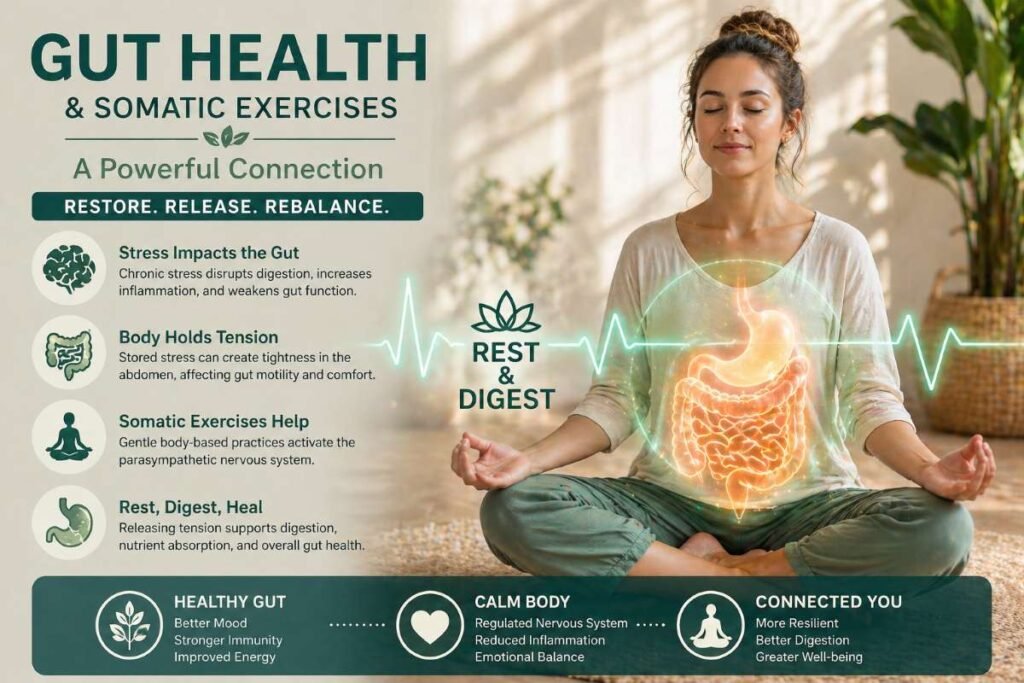
Your gut health and somatic exercises for trapped stress & trauma share a deep biological connection. The “Enteric Nervous System” in your gut is often called the second brain. When you are in a state of “Fight or Flight,” your body shuts down digestion to save energy for survival. This is why chronic stress leads to bloating and IBS. By performing somatic movements that target the midsection and diaphragm, you are literally “massaging” your internal organs back into a state of rest and digest.
- 🥗 Metabolic Repair – A gut health guide for beginners can help you address the inflammation often linked to chronic emotional distress.
- 🥦 Dietary Synergy – Incorporating high fiber foods for digestion ensures your body can efficiently process metabolic waste during recovery.
- 💧 Hydration – Water is essential for flushing out the lactic acid and metabolic waste released from tensed muscles.
- 🧪 The Microbiome Link – A healthy gut helps produce the GABA needed for nervous system calmness.
Conclusion: Your Body is Ready to Heal
Somatic work is a path to reclaiming your true self by releasing years of stored tension. By calming your system before sleep and listening to your body’s needs, you create the perfect environment for a deep emotional and physical reset. For too long, the modern world has asked us to live entirely in our heads, ignoring the wisdom and the pain stored beneath the neck. In 2026, we are finally realizing that mental health is a full-body experience. Whether you are dealing with past trauma or the daily grind of USA life, your body has the innate capacity to reset. All it requires is your attention, your breath, and a little bit of movement. Start today, and give your nervous system the “safety” it has been craving for years.
- 📍 Action Item – Try the “Butterfly Hug” right now for 2 minutes to feel an instant amygdala reset.
- 🕒 Be Patient – It took years to trap the stress; it may take weeks or months to fully release it.
- 🥗 Nutrition Matters – Support your nervous system by choosing heart-healthy foods that provide the essential building blocks for cellular repair.
- 🔋 Long-Term Thinking – View somatic work not as a “fix,” but as a lifelong conversation with your physical self.

Frequently Asked Questions
1. How fast do these exercises work? Many feel an immediate chest or jaw release. However, for deep healing, 10-minute daily sessions of somatic exercises for trapped stress & trauma are recommended.
2. Are they safe to do alone? Yes. Most somatic exercises for trapped stress & trauma are gentle and designed for home use, focusing on internal sensations rather than physical strain.
3. Why target the Psoas muscle? The Psoas stores your “fight-or-flight” energy. Releasing it is the main goal of somatic exercises for trapped stress & trauma to reset the system.
4. Is crying or yawning normal? Absolutely. Yawning, sighing, or crying means your nervous system is finally “discharging” stuck survival energy and returning to a state of safety.
5. Can seniors practice these? Yes. These are low-impact micro-movements, making them perfect for seniors or anyone with limited mobility looking for emotional relief.
🏁 Your 2026 Somatic Healing Checklist:
- 🛒 Investment – Get a high-quality cork mat for grounding; avoid slippery synthetic mats.
- 👟 Low Impact – Focus on the quality of sensation, not the quantity of reps.
- 🧘 Professional Help – If you have deep PTSD, always work with a trauma-informed therapist alongside your exercises.
• 🛌 Sleep Priority – Deep release happens during REM sleep; ensure you follow best practices for sleep optimization to maximize your recovery.
✍️ About the Author
Dambar R. is a dedicated wellness researcher and the visionary founder of MyHealthyLifeUK. With over a decade of hands-on experience in metabolic science and practical nutrition, he specializes in creating sustainable health transformations for modern lifestyles.
Based on his extensive research, Dambar empowers individuals across the UK and USA to reach their peak fitness goals through science-backed health tips without sacrificing the joy of everyday eating. His mission is to bridge the gap between complex health data and actionable habits that foster long-term vitality and holistic wellness.
⚠️ Medical Disclaimer
The information provided on MyHealthyLifeUK is for educational and informational purposes only. It is not intended to be a substitute for professional medical advice, diagnosis, or treatment.
- Professional Guidance: Always seek the advice of your Physician (GP) or another qualified health provider regarding any medical condition.
- Specialized Advice: For personalized dietary needs, we recommend consulting a Registered Dietitian.
- Safety First: Consult a professional before starting any new fitness or nutrition program.
Never disregard professional medical advice or delay seeking it because of something you have read on this website.